Dulčić Šimera Mirella
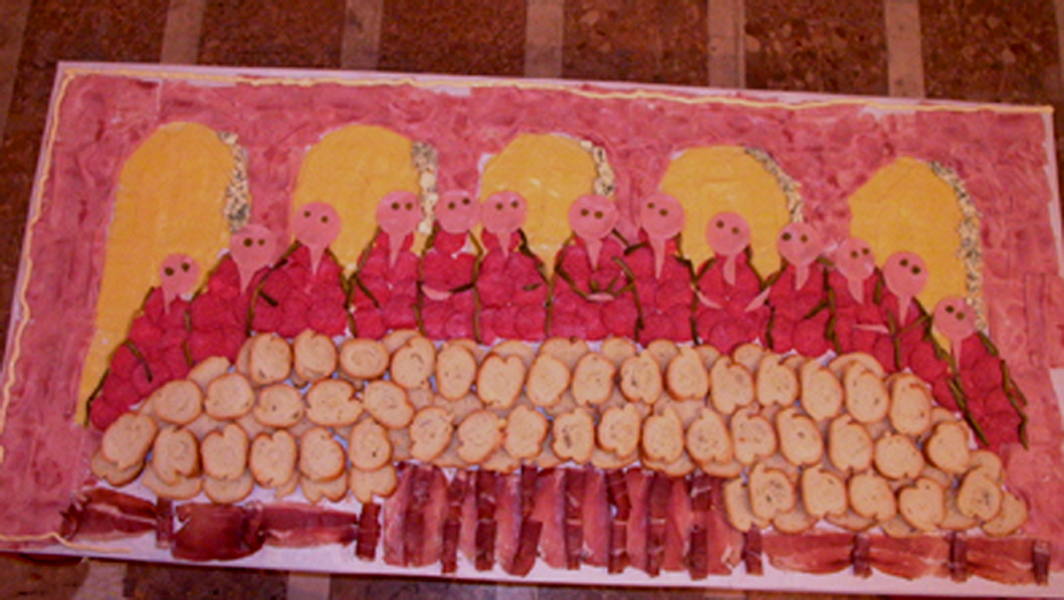
Why Eat the Last Supper, installation.
"O2" Gallery, 2004 Vrbovska, Hvar
If you think that even touching and "listening" to a picture doesn't belong to conventional ways of "seeing," what will you say about a picture that you can not only freely touch, but also look at and listen to, because every part of it produces noise? What will you say about a picture that the artist literally offered for dinner? As bizarre as it may seem, the thing is by no means so strange.
The author decided to enrich and enhance the perceptual range of her works with the sense of taste, and to turn the passive observer into an active participant without any intention of frightening, provoking, humiliating, or mocking that same participant in the name of some "higher art.".
Through her entire series of exhibitions, almost every one of which questions the problematic relationship between artist and society or artist and artistic act, Mirela Dulčić has also, with this installation, decided to prove that art can be communicative, witty, and literally understandable.
Zvonko Todorovski
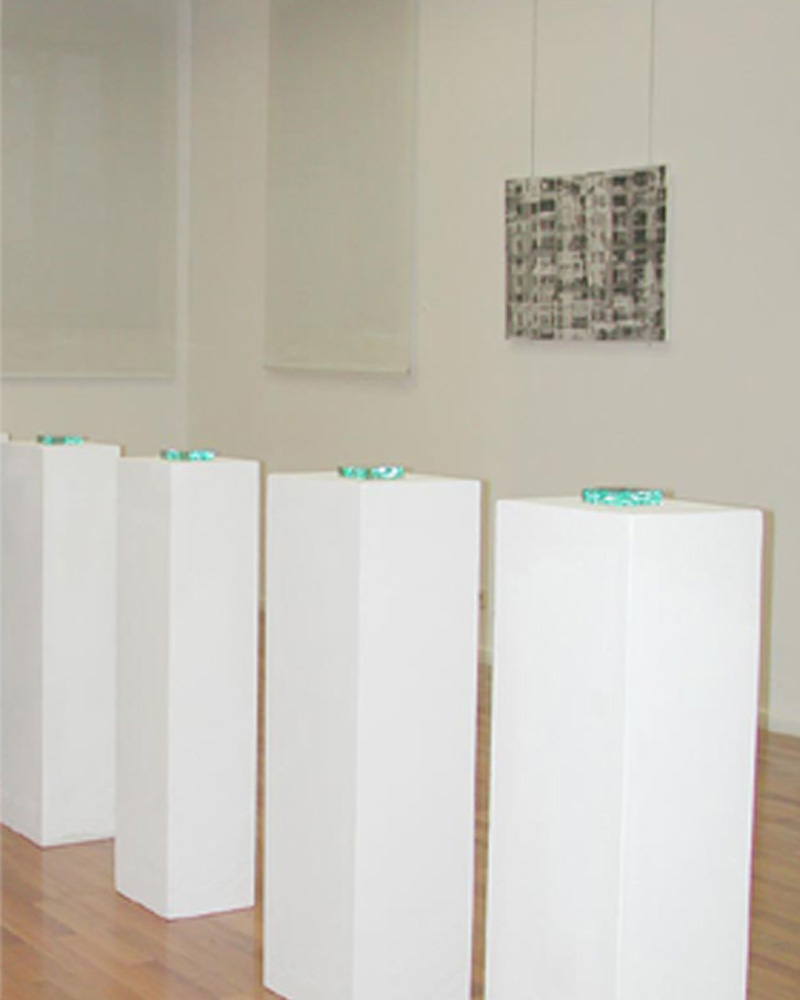
Project: "FORGOTTEN PLACES", MKC - Split 2004.
Part of the catalog text:
The work was created in 2002 and marked the beginning of a phase to which the author remains consistent - the life of an idea and its transformation over time.
"The work that depicts the transformation of an idea through time seemed interesting to me, along with the story of space, whose fate is to always and only provoke ideas and live within them, while its material basis remains unchanged. I like to engage with the question of simulated reality, something that lives in multiple ways and in multiple forms. What is real reality?"
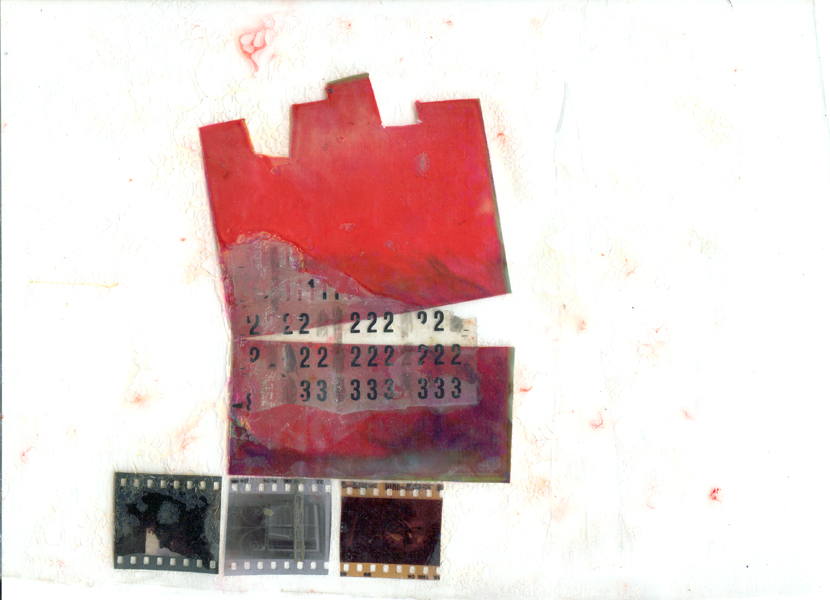
The characteristic of the Youth Center space is its multilayered unrealized potential. Negatives preserved in PVC, small paintings with frozen totalitarian visual codes, delicate dance scenes, and dislocated fragments of language tend towards trash aesthetics and, on an ethical level, evoke commentary, while on an emotional level, they induce tension and discomfort related to, realistically, non-threatening content.
Tamara Visković
REALITY CONSUMPTION MKC - Split, 2003.
Computer-manipulated photograph - Canvas print
Sometimes subtle and pure, sometimes aggressive and obvious, Mirella Dulčić distances the observer from the system of signs perceived by the consumer, positioning herself like an invisible switchman between reality and our perception of reality, between a series of categories we take for granted. The artist has no choice but to speak the language of consumer culture, exposing its myths, that which is culturally smuggled in under the guise of the natural.
Tamara Visković
Gallery of works