Vladimir Davidenko
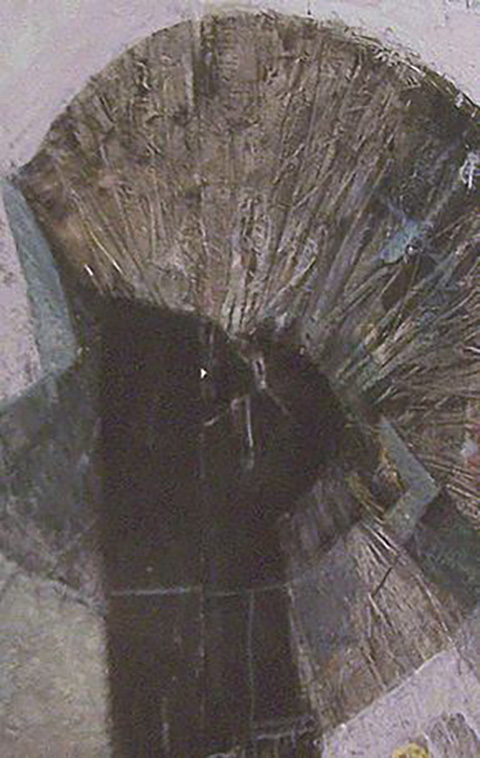
Before us are Davidenko's latest works, which, through research in the urban landscape, among layers of city asphalt, worn by tires, from countless journeys—sometimes joyful, sometimes tragic—that have left the trace of their lives on simple surfaces—are searching. For what?
His optics do not wish to look at the microcosm of animal lines, decomposed and meaningful in the end; he is not interested in the steppes or tundras of his ancestors, least of all in the realism of Ilya Repin. Malevich is also not to his liking. He is too bare, too "designed," in his search for a pure symbol. All of this is too framed for him. And indeed: when you see Davidenko's paintings, they somehow break out of the format—they seem larger than a meter would suggest. Not only because of the texture (depth, layering), but also because they escape the frame, because there is no classical composition here, nor a clear symbol that would frame your imagination.
What drives a painter to paint, other than an inevitability that is beyond them, other than a question mark, in pursuit of an unclear form? Davidenko abstracts abstraction to return to concreteness, to the existential, to some "nest," even though they know that this nest is a probable fiction, but ultimately abstraction, therein lies the secret of the paradox.
A similar drama unfolded on the squares of the chessboard, as Marco Polo described the microcosm and the essence of abstract planes to Kublai Khan. The Great Khan, however, was grappling with a sphere (circular), the geometry of an infinite yet bounded flat plane, with the Cosmos enclosed in an egg.
Davidenko's microcosm expands and pulsates from within, in principle free from scheme and theme, from the given. His lines and textures aren't appealing for no reason – like an asphalt zebra in its everyday life, with some mystical purpose and meaning – because this makes them enigmatic.
Under the neon light they stand like faded graffiti, hiding other, different graffiti beneath them, and so on infinitely, until what only seemingly fits becomes rhythm and rhyme.
S.B.
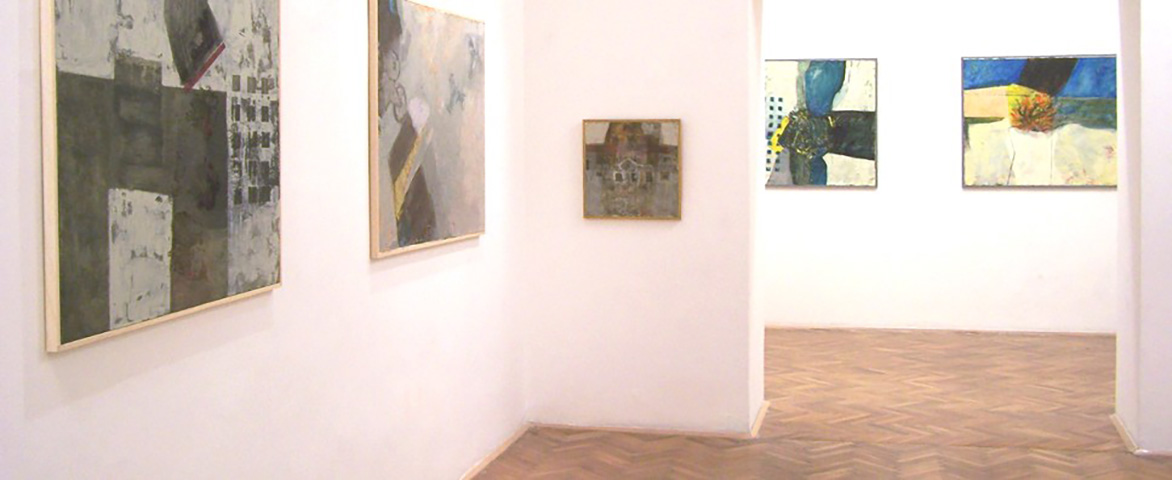
Gallery of works