Ostojić Jerolim
ON THE PAINTING WORK OF JEROLIM OSTOJIĆ WITH A BRIEF COMMENTARY ON DRAWINGS AND PRINTS
The artist's life is intertwined with inclinations, loves, curiosity, and various activities related to many things and phenomena. He studies life and areas of interest by observing, listening, and constantly learning. The knowledge, impressions, and influences of the Classical Gymnasium in Split, the study of art literature and works, as well as studies in medicine, law, mathematics and physics, painting, and frequent travels visiting galleries around the world, are all influences that flow into his paintings, drawings, prints, and set designs. There are also numerous exhibitions, solo and group, from his native Trogir through the cities of Split, Zagreb, Rijeka, Dubrovnik, Osijek, Novi Vinodolski, Chicago, Budapest, and many other cities both at home and abroad. Now the artist is contemplating new paintings, rounding off his work so far into a "general phase," and when the entire year will be fully interwoven with sketches, drawings, oils, prints, set designs, artistic gatherings and colonies, exhibitions, and study trips.
He was born on the threshold of a summer (1943) in Trogir, a city museum, a city both sunny and shadowed, a city that floats in the sea, slowly sinking, a city where the whole world mingles, famous and unknown, constantly revealing itself, large and small, with magnificent buildings and weed-overgrown ruins.
On the occasion of a painting exhibition held at the premises of the Croatian Paneuropean Union in Zagreb, an article titled "Truth and Beauty" ("Hrvatsko slovo," December 2001, by Nevenka Nekić) stated, among other things:
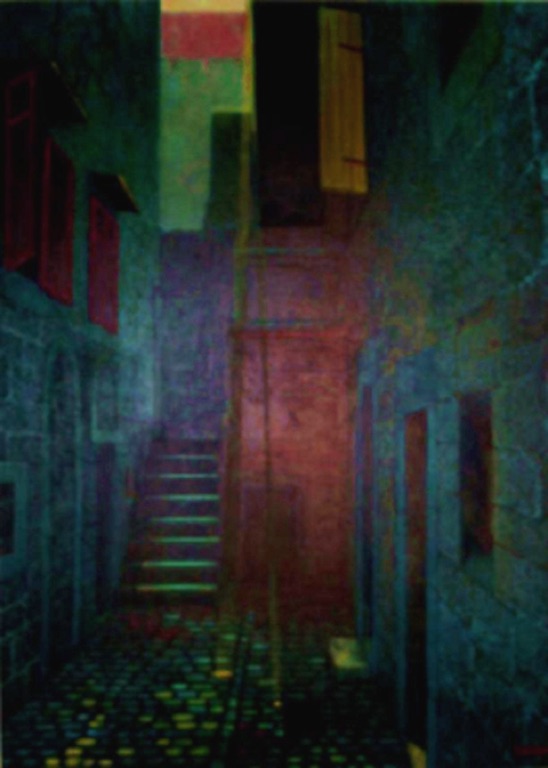
"…From his personal and artistic biography, it is evident that he belongs to the group of "seekers" and that through his various phases he explores different possibilities in painting in terms of technique (at one point even working in pointillism), color, light, and composition. This is complementary to his personal interests, which led him to study various subjects—from medicine, physics, and mathematics to law. This thirst for knowledge and his travels to various countries around the world also resulted in transformations in his painting throughout his career. Therefore, art criticism distinguishes several phases in this artistic "development": his painting began with an intoxication with old Trogir, its stone and ancient spaces, the warm colors of its narrow streets. This exploration continued with an immersion in light and shadow, then with a divisionist breakdown of the surface into dots of a specific pointillism, dominated by the color blue, before the artist returned to old Trogir with new sensory visions of light. Of the exhibited paintings, the painter himself says they would belong to a new school of painting that could be called the materialization of light.
The fact that the painter Ostojić meticulously prepares his drawings and constructs the compositions for his oil paintings, that he uses the world of mathematics as his profession, still cannot explain the ultimate effect and the specific metaphysical world of this painter in which light plays the main role. An almost straight line is applicable to this flow of light, as are the sharp Mediterranean shadows cast by stone architecture. The final effect remains a certain mysticism and metaphysics of uninhabited space. These are large models of a city with its streets and vistas, fatefully connected to the author. Does this painting, expressed through an almost mechanical transfer of measurements and a kind of stylistic severity, through the modulation of light and dark, a space where only light that echoes through orderly architectural or similar scenes truly lives, does it reveal a need to overcome chaos, to create one's own world of newly assembled matter in a time that resembles infinity? And how is time at all introduced onto a flat surface?
The composition in this painting is meticulously, almost mechanically, projected into a linear or some other cubic sphere, with the intention of adding the inexpressible, the metaphysical, the mysterious, and the enigmatic in a Kirikovian, Vanistian manner. All the painterly elements seem to serve this purpose.
As if the painting brings a wondrous inner screen that projects questions, dark premonitions of hidden incidents behind the walls, flickers of life behind the horizontal planes of the sea. The painter is fascinated by the planimetric projection of the architectural world, dominated by surfaces, and the premonitions of life, as there are no human figures here, are left to the bright windows or the promise that it exists in the promised intimacy of a darkened room.
Introducing colors into that world, which graduates in values of a warm or cold spectrum, complete within a single image, the painter gives it in a tonal chord of light or dark, the main place in the scene, at that point the essential is focused, there is the focus, a chaotic summarization to which it leads us with a firm hand, a visible line that ends in that fourth dimension.
And so we arrive at the image that thinks towards us, impulsively and articulately transforming into the ineffable core of the artist's being, where his truth and beauty are concentrated.
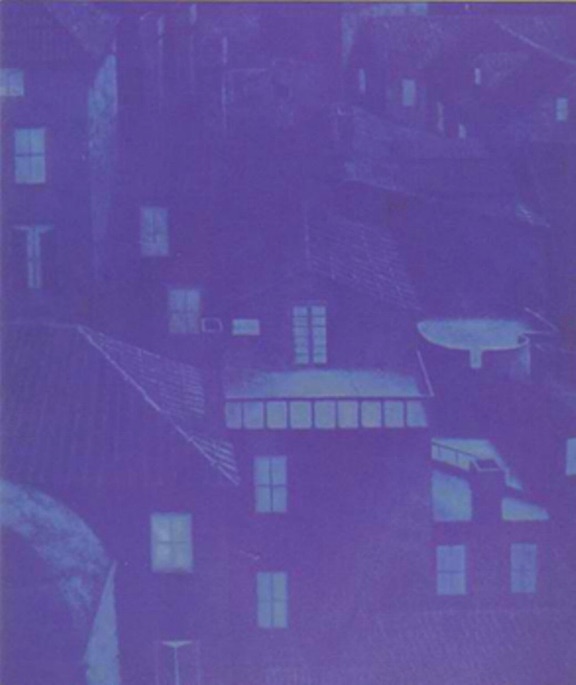
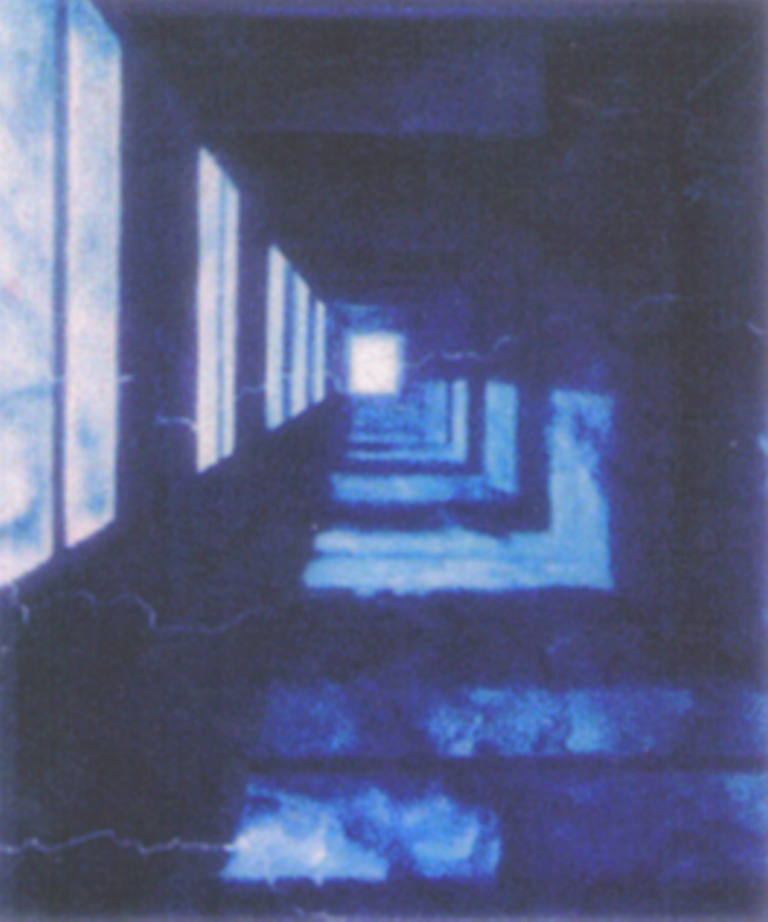
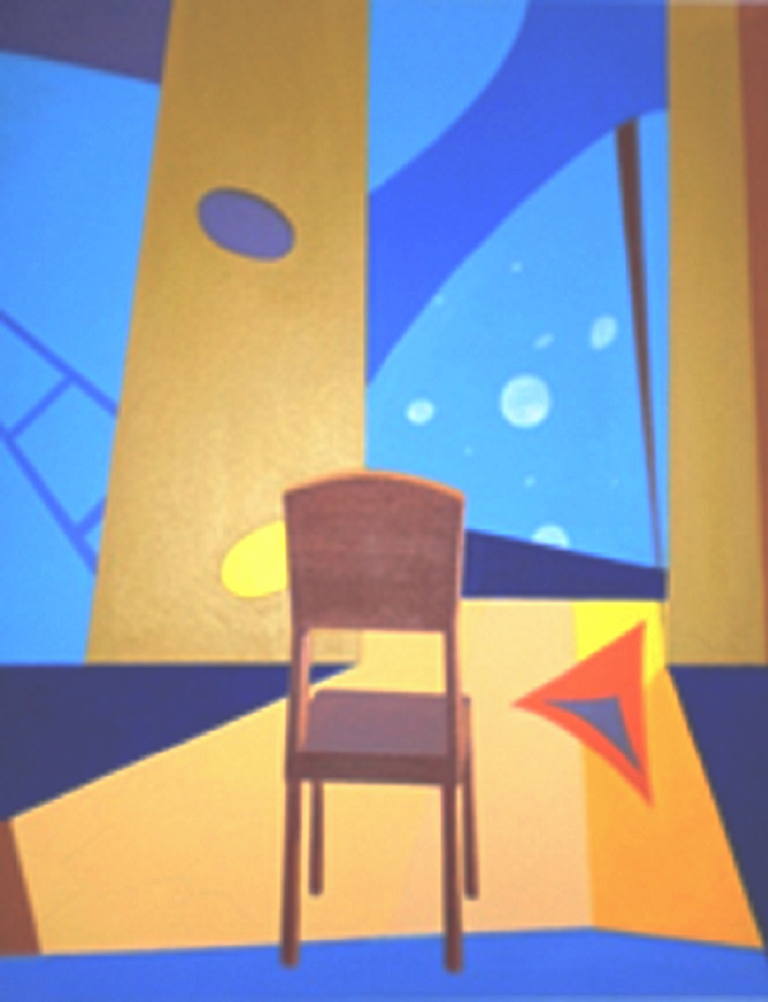
Jerolim Ostojić's work can be divided into several phases. The first phase is described as: "His painting emerged from the first nostalgic motifs of Trogir, old interiors, and small houses...it is a peaceful world of semi-dark taverns where even the most intimate messages and desires are confessed...a world when one enjoyed the moonlight, nostalgic sunsets, and night tides, when the weave of thoughts and emotions in terms of external manifestations was almost subdued, but very strong in the depths of each individual." In the first phase, aside from a few works on cardboard and plywood, the paintings were created with oil or tempera paints on canvas, and the majority of the works were created between 1972 and 1976. It should be noted that all paintings were preceded by sketches, or drawings on paper, and in some other phases, by graphics. Part of this has been preserved and can constitute a separate body of work (about fifteen graphics and a larger number of sketches and drawings). The second phase is most often referred to by authors as the "Sun" phase. Inspired by the Sun of Dalmatia and Sardinia, and especially by the "burned" earth of Sardinia, he begins a phase and a special way of working that will follow him in one way or another. The Sun makes everything possible, maintains what exists, but it also destroys. This is not about some paganism or fatalism. These are simply facts, a certain perspective on reality. To some extent, the shadow can oppose the Sun, but over time it will overcome everything only to extinguish itself after a short life as a nova (a red giant) and an explosion. In the paintings, the Sun mostly appears as "Light from Nowhere." The colors, specially imprinted on yellow-dyed canvas, are dominated by the ochre-terracotta gamut. These oil-on-canvas works were predominantly created between 1976 and 1980 and are largely located in the USA. The third phase differs from the others, but only technically. At first glance, it is Pointillism; however, the dots here are not just for simultaneous contrast, but they are also the essence and the element. Their arrangement and restructuring are a natural consequence of their very existence. It is, in essence, a view of reality, but in a special way. Here, the painter uses his knowledge of mathematics, physics, chemistry, cosmology, astronomy, quantum mechanics, computer science, and more, although all of it is somewhat hidden. Here, the dots are both the essence and the element. It is enough to list some concepts and phenomena for it to become immediately clear that this is the world (albeit still insufficiently explored) in which we live: elementary particles, strings and superstrings, crystals, cosmic systems (including our own Solar System), stars, galaxies and their clusters, neutron stars, mysterious pulsars, black holes, cosmic dust, dark matter, matter-antimatter, radio galaxies, quarks, waves of matter, tachyons, the God Particle, set theory, group theory, Hilbert mathematics, Lobachevsky mathematics, general and special physics, n-dimensional space, polymerization, superconductivity, cloning, robotization, computers, chips, bits…These are inexhaustible fields for any work, including painting, and so they must certainly be taken into account. The painting backgrounds are either blue or dark brown (cool-warm), which somewhat symbolizes the macrocosm and the microcosm. The colors are applied to the surface (blue or dark brown dyed canvas) with the other end of a (sawed-off) paintbrush. The dots (of various colors) are arranged according to the principles of certain painterly contrasts: warm-cool, light-dark, simultaneous contrast… The paintings were created mostly between 1980 and 1985 and, compared to most paintings from other phases, are larger in size. So far, the fourth phase is the most prolific. Ivan Bošković, in the foreword to the 1986 exhibition catalog, states: "A good connoisseur of Ostojić's painting will quickly and easily notice that they are standing before works… from the painter's creative period in which his previous experiences and explorations are being rounded out (both in terms of visual art and ideas…)" and further: "In the "Heat and Shade" cycle (fourth phase), we encounter the characteristic motifs of the first phase ("...nostalgic images of old Trogir, imbued with the patina of bygone times, warmth, and intimacy..." ), as well as the dominant role of light, which is one of the essential characteristics of the second phase, and that special angle of view from the third period, in which the pictorial motifs are approached analytically, delving into their essence rather than dwelling on the appeal or peculiarities of their outward appearance. However, this familiar painter's world takes on new contours, sometimes ghostly, almost terrifying. We are faced, in fact, with images of a mysterious and enigmatic world in which there is no human. Everything that reminds us of him is there: his city, his home, so many traces of his life and work. But the man himself is gone! Where has he vanished to? Perhaps the answer lies in those omnipresent cracks, those symbols of transience! The transience of time, life, and man… Ostojić presents himself as an artist who does not approach his motifs exclusively as grateful pictorial subjects, but rather uses them to convey his thoughts and insights about human life. It would therefore be a mistake to see in these works only "beautiful pictures" that are compositionally harmonious, coloristically pleasing, and rhythmically balanced, and not to see their conceptual foundation. For they are not just the result of the painter's experience, but also of philosophical insight…The cycle simultaneously confirms that for him, painting is not just a passing whim, a pleasant pastime in his free time, but a lasting need to immortalize his vision of the world with his brush—a world that is so beautiful, harmonious, and picturesque, but without man, cold, unimaginable, and unreal…".
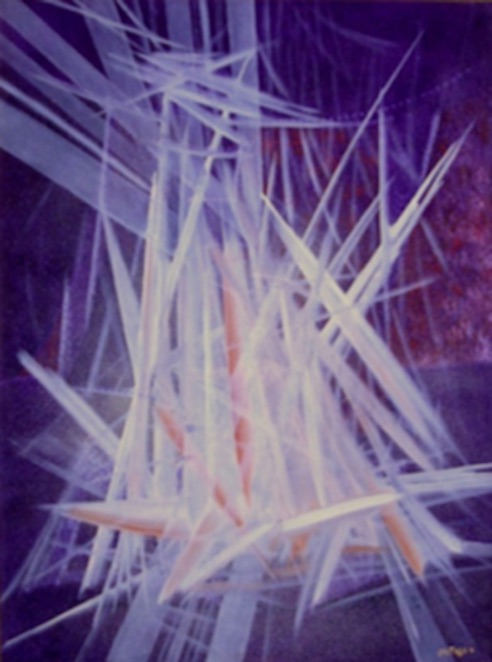
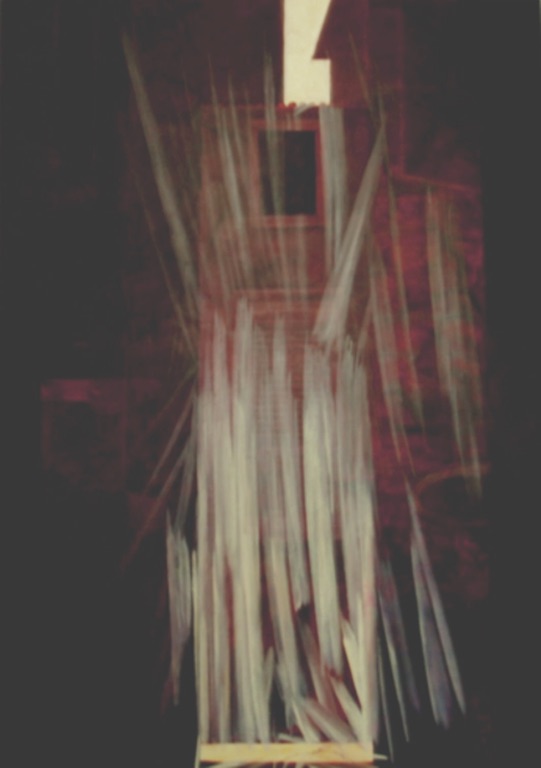
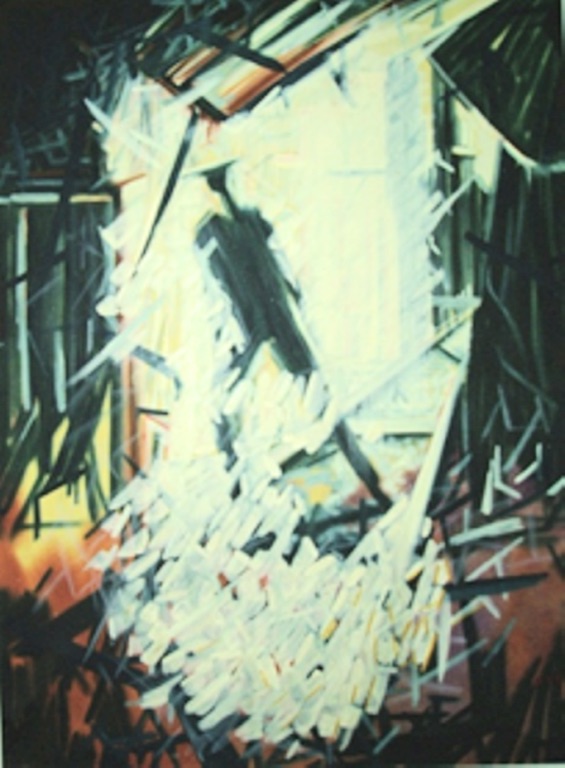
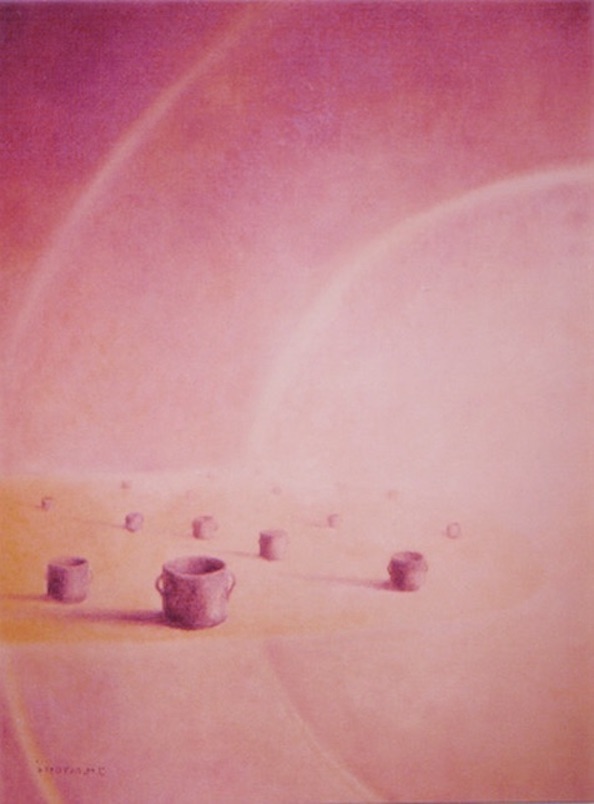
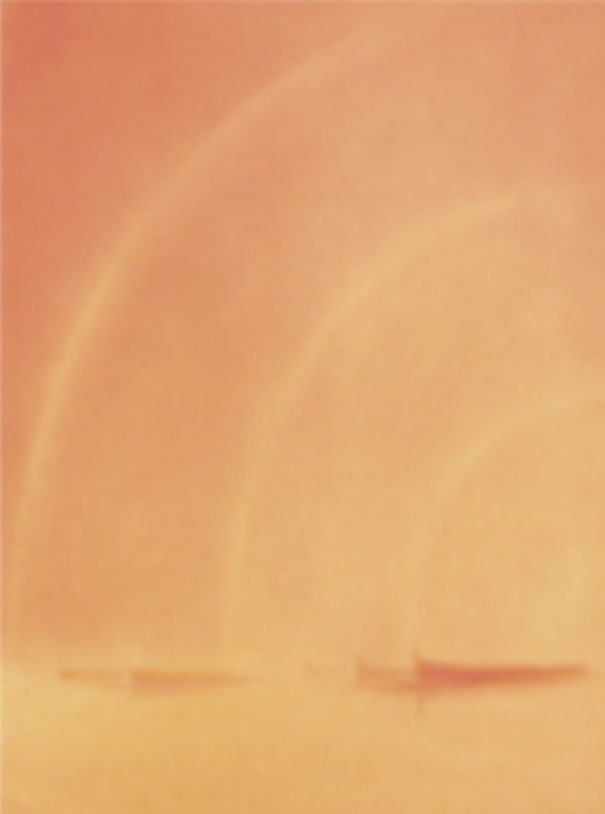
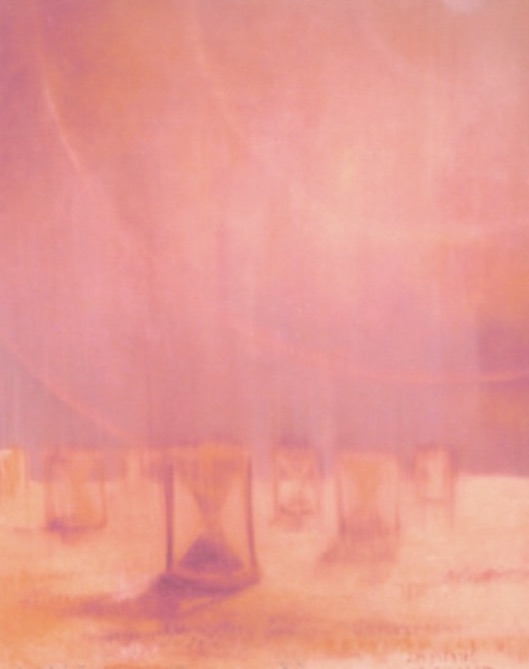
Paintings from this phase have been shown in many exhibitions and are the most numerous, especially those from part "A" (heat). The "heat" and "shade" are otherwise easily recognizable by their colors, particularly those from part "B" (shade) with their blue hue. The most paintings from this phase were created between 1985 and 1991. More recently, the painter has been working on paintings that belong to phases with the working titles: "Materialization of Light (Energy)," "Rematerialization of Light" and "From 3D to 11D," perhaps unifying all the phases. Light (an electromagnetic wave, energy in motion—which is a prerequisite for it to be seen) is depicted as materialized on the canvas as color, a distinct or less distinct object. Images from "Abandoned and Forgotten Spaces" are placed into the "Disassembling and Reassembling of Matter" spaces, and then those from "Materialization of Light" are brought in at the level of unfinished or undefined object-forms, which are still partially energy, which is actually a type of assembly as well, except it doesn't dominate the image but is its equal part. In this way, another dimension—a temporal one—is actually created. This is then a 4-dimensional image, but also a step towards a multi-dimensional image (4D-11D). For this, one needs to find "smart" symbols and have the right choice of colors, or paint the same scene at least twice, once in monochrome and once in color. After all, one must sometimes defy the impossible and create one's own world (to one's own mental measure), but always knowing that the Universe is also one's world, that one is also a part of the initial Big Bang and the current expansion of the universe (into infinity or not?), its black holes, pulsars, dark matter, gravitational fields (gravity unifies all natural forces), various radiation, spacetime and its warping, temporal slices, probability waves, the uncertainty principle, special and general relativity and classical physics (as the embodiment of what we know about reality), the speed of light barrier, the Higgs field and ocean, string and superstring theory, ether and light-ether, the symmetry of the experience of time with entropy, time travel through intricate paths (and into the past?), travel through space (via wormholes) and access to multiple worlds (opposite world), the influence of future events on the present (and on the past?), memories of the past and future, electromagnetic arrows of time, the EPR paradox, the God particle… etc.
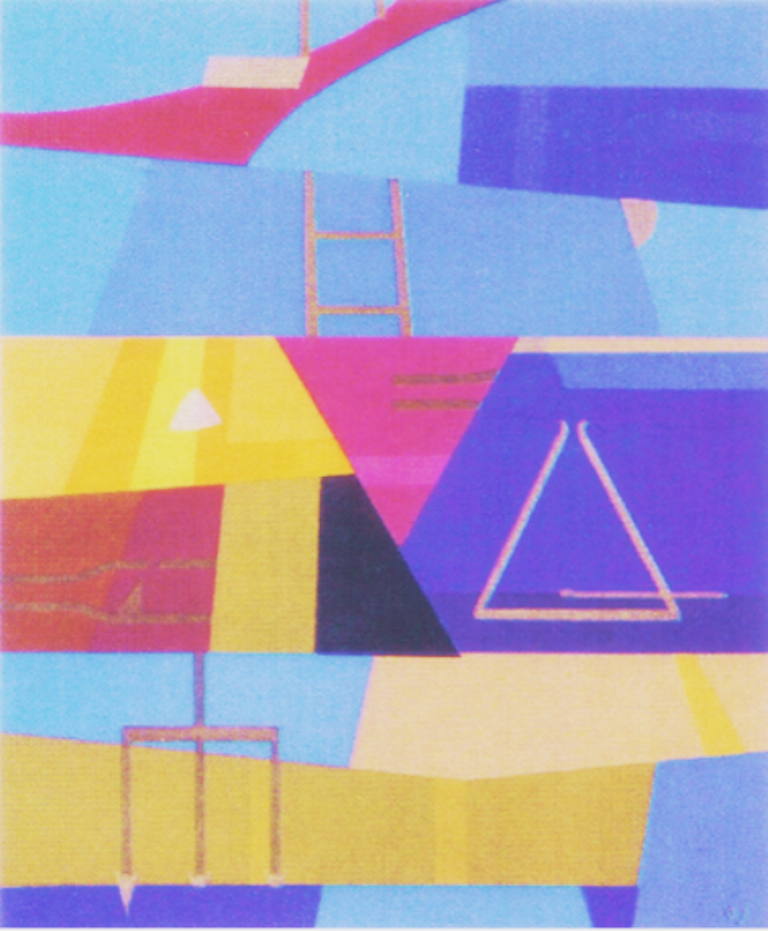
Ostojić now portrays reality, but one that is not visible at first glance, perhaps not even at second. This is about general reality, which is described by general mathematics, thus general physics. There are also some details as representatives of a special reality, such as details adapted to our (three-dimensional) senses that belong to the realm of Euclidean and Newtonian low speeds, i.e., objects and their corresponding ideas (or ideas themselves) from everyday (earthly) life. There are also symbols that point to that general reality, through the triangles and hyperbolas of Lobachevsky and Hilbert, and symbols in n-dimensionality, but also religiosity. The chosen colors also serve this purpose; different colors also mean different fields of energy, and thus matter.
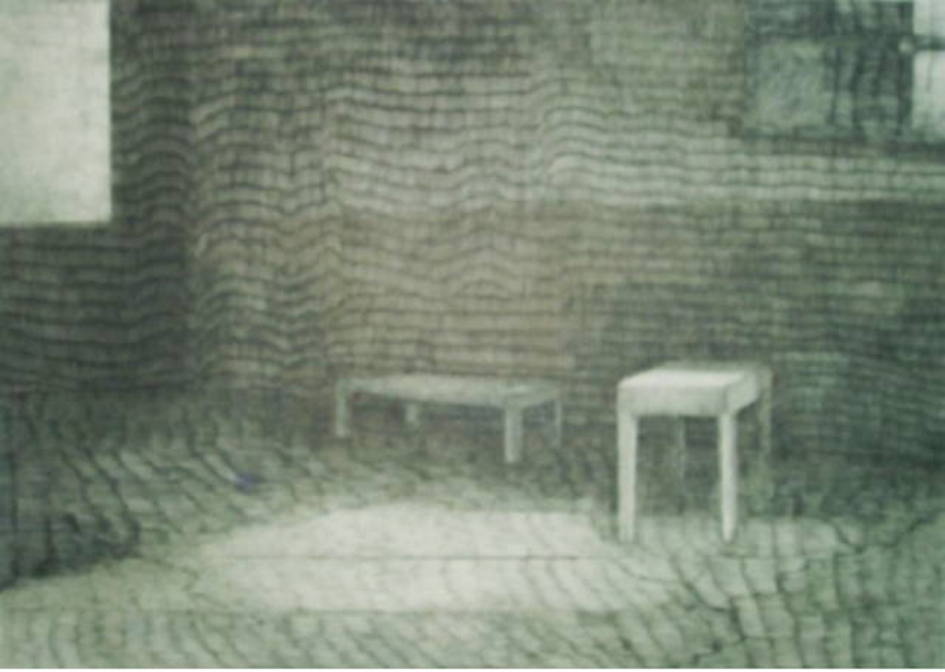
Human beings, as an important (or is it?) part of that universal reality, have always wondered how significant that importance is and what their actual role is in all of this that has been given to them. Do they have any influence on everything? He does not know (yet) whether the universe will expand forever or if it will again undergo "big bends," and whether organic life is merely an episode and segment of spirituality that will continue here or anywhere within the framework of eternal spirituality. Parts of these reflections are also present in the paintings. His latest works (all oil on canvas) have so far only been shown to the public at group exhibitions in Budapest and the international art colony in Hajdúböszörmény-Debrecen, as well as a few paintings in Zagreb at the premises of the Croatian Pan-European Union, more as an introduction to the phases "Materializing Energy" and "From 3D to 11D." In parallel with the oil-on-canvas works, and even before them, Ostojić constantly creates sketches, drawings, and prints, which then often serve as ideas or direct sketches for the oil paintings or for set design. Of these works, the most significant is a graphic map titled "Left and Abandoned Spaces," which has been featured in several solo and group exhibitions. Part of these prints are also included in the bibliophilic print portfolio "Tempestas" by T. Politeo, which was exhibited in the "Tempestas" train on August 5, 1996. On the occasion of the print exhibition at Gavella in Zagreb, E. Cvetkova, among other things, says: "The graphic map by the Trogir painter and printmaker… was created as a direct reaction by the artist to the recent war. Instead of any description of the horrors of war, the strict and unassuming Ostojić chooses another path: he depicts the anxiety experienced in desolate and empty spaces that people have abandoned because of the war… Uninhabited cellars, docks, stairwells, hallways, basements—spaces where life once thrived—lie empty? There are no living beings, only traces of humanity's former presence. From narrow openings, light pierces through, emphasizing the materiality and structure of the rocks and the volume of the space. The light also dramatizes the darkness, confronting it. Everything exists, just as it once did, except that a terrifying silence and emptiness have taken over. Thus, these shaped interiors have become interpreters of the psychosis of fleeing an onslaught. By composing elements from his native environment, the author has created a visual lexicon of the drama of the moment. In reality, there is a shift from the true, sometimes in exaggerated sizes, sometimes in an unusual slice of an interior, in strange relationships between parts. An impression of order and harmony is created, one that only a human can create, but it is abandoned, completely silent, a source of unease and anxiety… But the vision of cities without people, fortunately, did not permanently occupy the artist. In a climate of vivid color and people of a fiery temperament, misfortune was always regarded as a moment that joy, often even burlesque merriment, outlives. In some sheets of the portfolio, modest traces (or already developed expanses) of intense colors radiate. Opposed to the dark-light of the monochromatic space, these traces are too warm and dynamic to remain solely symbolic of human suffering. From these "juices," new life sprouts, and for this reason, this is not a map of despair. The evocativeness of these sheets is created by the artistry of old graphic techniques. The meaning of the tonal relationships of Rembrandtian origin has also been assimilated, but Ostojić has breathed autonomy into them. For this reason, this map can be considered a successful contribution to the artistic oeuvre born from the impression of war."
SIGNIFICANT EXHIBITIONS:
Trogir (1974, 1976, 1977, 1979, 1982, 1985, 2010),
Split (1979, 1980, 1986, 1989, 1996, 1998, 1999),
Zagreb (1975, 1996, 2001/2),
Chicago (2000),
Dubrovnik (1980, 1996),
Osijek (1996),
Rijeka (1985),
Novi Vinodolski (1983, 1984),
Travnik (1985),
Veliki Borištof-Gradišće-Austria (2000),
Budapest (2004, 2005, 2010),
Hajdúböszörmény-Debrecen (2011, 2012).
Gallery of works