Emil Trutanić
Emil Trutanić
„Animalism“
From early creations and experiences with stone, to abstract stone sculptures hinting at figurative organic/biomorphic forms, Emil Trutanić consistently demonstrates a preoccupation with the world around him. He uses underwater and above-water motifs as his means of expression, and with this exhibition, he returns to natural materials such as stone and clay.
The theme is animalism, and animal motifs become symbols and signs for certain phenomena of contemporary society and humanity's treatment of other living beings. The animalistic genre has existed as long as humanity itself, from the magical depictions of cave paintings all the way to recent visual art production.
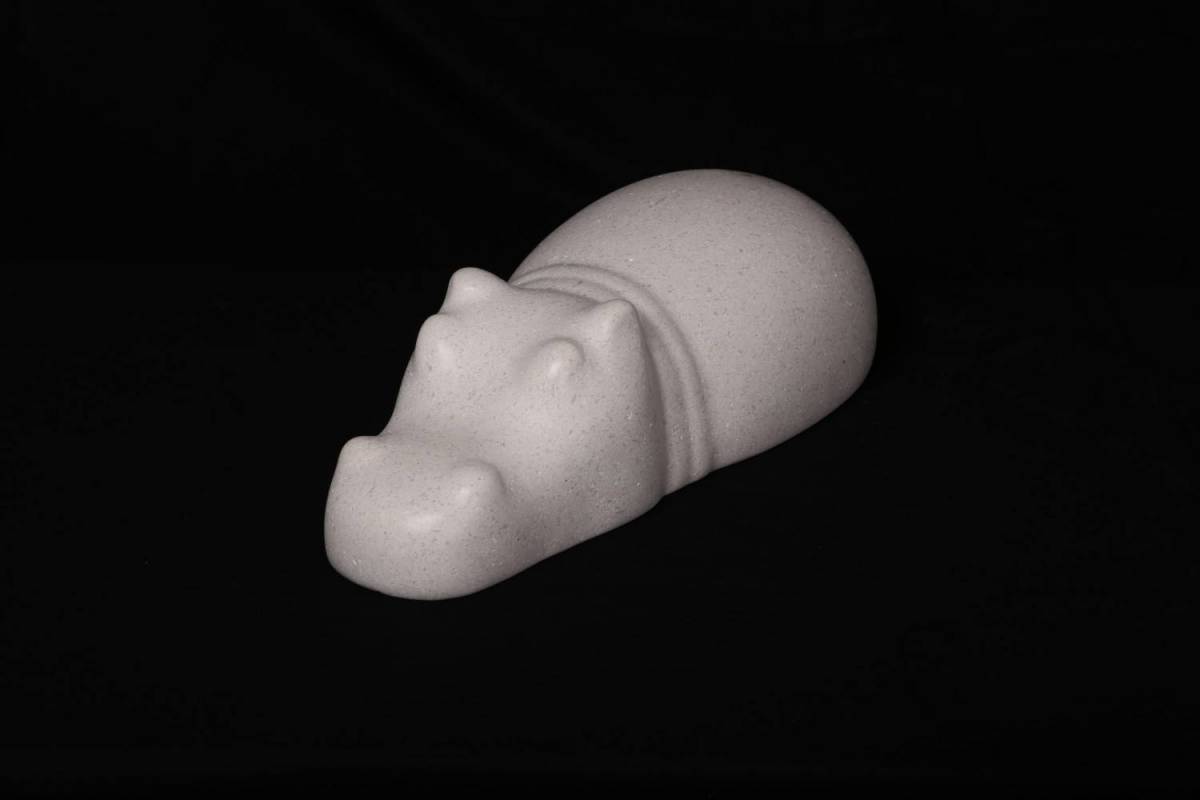
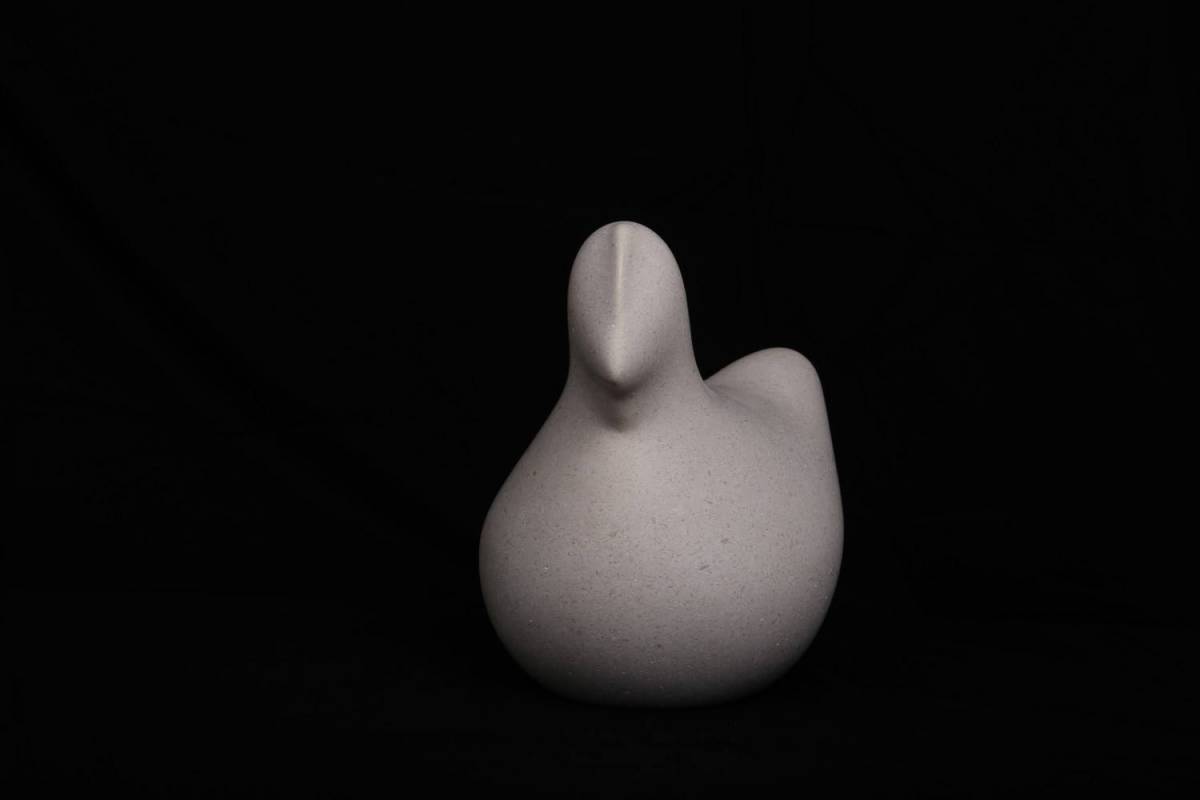
Trutanić's animal sculptures are polished to a high sheen; the exceptionally smooth texture combines both sensory experiences, visual and tactile, and there is a desire to touch these stone forms, which was the artist's intention.
All sculptures are made from natural materials, primarily Brač stone, which always represents the artist's connection to their homeland. Although the forms are quite stylized and abstracted, all sculptures retain recognizable visual structures of the specific animals they represent.
All parts emphasizing the distinction between individual animal species - heads, snouts, horns, and beaks are shaped and modeled in Trutanić's elongated, recognizable style, which becomes his specific sculptural expression, giving consistency to all exhibited sculptures.
The author chooses various types of animals, from marine ones like lobster and octopus to land animals and even birds. Mostly, they are animals that can be found in our climate, but there is also a giraffe that represents other continents, giving the concept a globalist and universal aspect from a different perspective. It is turned with its "gaze" towards the other sculptures, while they are directed towards the giraffe, creating an effect of mutual communication.
According to the author himself, animals have always been his inspiration and support in life because we can only hope to achieve that level of goodness that animals don't even try to achieve; it's inherent in them, which shows that animals are beings worthy of attention, not just objects or commodities as they are viewed today.
Barbara Gaj
„BIOMORPHIC ORGANIC FORMS“
Spatial and temporal dimensions merge into sculptural forms of eternal life flow: land and sea; underwater and above water, and through the changes of day and night (in my stone sculptures), completely new organic-biomorphic forms are created: the permanence of the experience of the sea.
Emil Trutanić
Emil Trutanić's Cypriot compositions can be described as volumes of meticulously crafted surfaces, inert to spatial breakthroughs. Space does not penetrate the mass but rather envelops it, emphasizing its compactness. Through its concave-convex parts, the mass disturbs the space, suggesting a mobility inherent to a living organism. Trutanić's sculpture undoubtedly carries an association with living organisms. The extraordinary dynamic quality of the sculptures is supported by an inner tension, which is also evident through the tension of the outer shell. These are compositions resembling organisms observed under a microscope, which, through the filter of imagination, transform and ultimately culminate in larger-scale compositions. It is not insignificant to emphasize that the artist's imagination is grounded in the Mediterranean climate, marked by the phenomena of the sea and the relics of organisms left in stone.
Associating a name with an artwork or form is a thankless task. There are examples where artworks endure different titles, and consequently, changed experiences (which doesn't necessarily have to be negative!). If it's about organic-biomorphic sculptural compositions, the danger becomes particularly pronounced. In such cases, experience forces us to recall, or compare with what we've already seen, thereby closing down the process of immediate perception. However, the title of a work can stimulate the imagination, which is the case with Emil Trutanić's works.
Furthermore, what is particularly noteworthy in this author's artistic production is the possibility of diverse placement of individual sculptures. Indeed, throughout the history of art in the last century, much has been debated about the role of the pedestal and the ways of presenting a sculptural work. In Emil Trutanić's sculptures, the pedestal is not really problematized. It is unnecessary precisely because of the "changeable" characteristics of the sculpture. Although some positions could be considered better than others, the advice holds that the sculpture cannot be placed upside down or turned "on its side." Such practice is not common in the field of stone sculpture.
What's interesting about these sculptures is the degree of polish, which, of course, depends on their characteristics. The tactile experience becomes of paramount importance because only it attests to the extent to which, in some sculptures, friction is eliminated, or the "flow" of touch is affirmed. It may seem superfluous to emphasize experiencing sculpture by hand, but it's important to remember that we live in a time when we are taught not to touch works of sculptural media.
Dalibor Prančević
Gallery of works