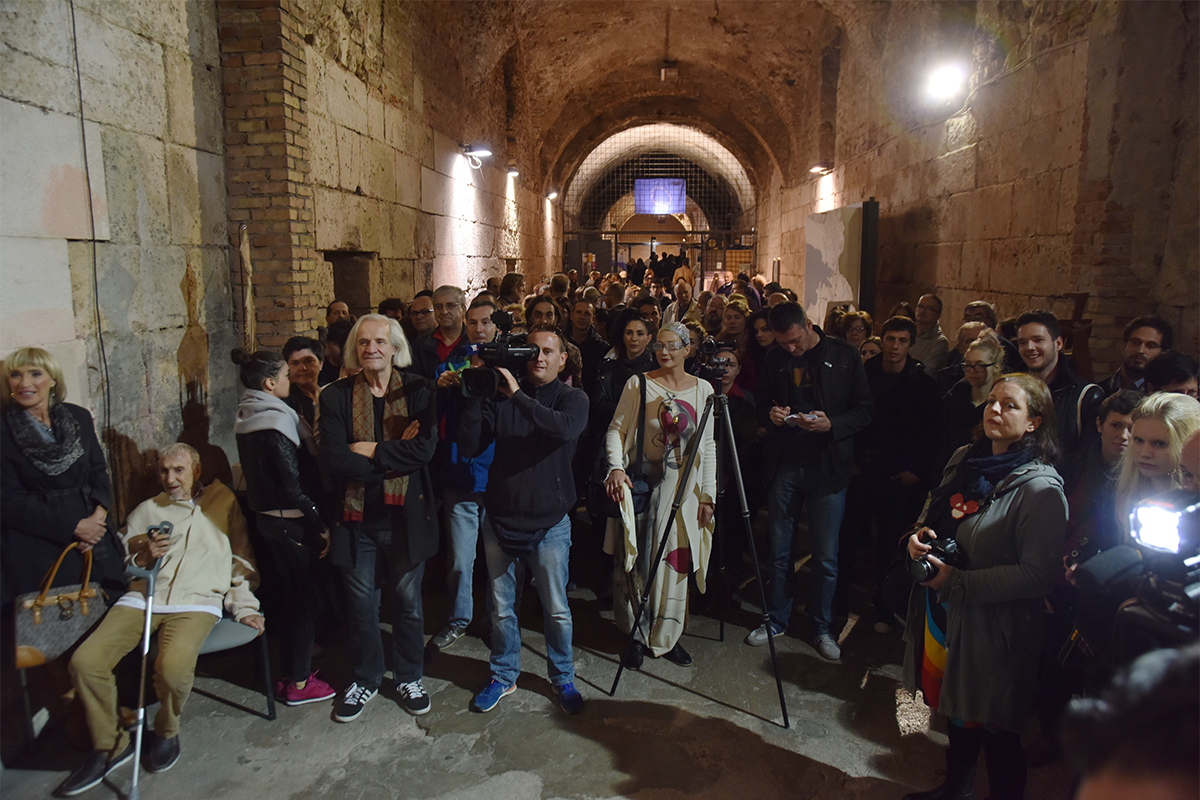
The 39th Split Salon arrived at a time when numerous dilemmas regarding the meaning of culture had not been resolved (from multiculturalism to a range of other characteristics, whether material, spiritual, intellectual, emotional...). new understanding of the image and the pictorial turn, as well as the exploration of well-known theories of social identity that contribute to new insights into culture. The results are devastating for those who think one can follow academically paved paths; the truth of the image and its reality must be sought within the image itself. Those who survived are the ones who did not wait but explored the questions of the image as a medium, of course, with a detachment from the world. Realities in painting are elusive, in constant transformation and material change. While the attempts of some painters and sculptors (out of 130, no more than a dozen!) may occasionally encourage us with their rich imagination and artistic personality, it is difficult to view the whole without knowing its point of origin, the temporal dimension, and the overall evaluation of the body of work, which is what essentially happened. A good number of the works seem like explorations in the field of contemporary art, like preparation for a study, something like a ”work in progress...” In a traumatized and disoriented world, can one expect anything other than a vague, stupid, impersonal, lightweight, and questionable product that, lo and behold, sells quickly as a ”child of the art system”? It may seem old-fashioned, but an intervention in the structure of the visible is achieved by delving into oneself and identifying with the object of interest. It is a complex process that results in a powerful experience of the world and its mysteries, a testament to an existential restlessness that questions the boundaries of one's own world. Good artists were undoubtedly also well-read intellectuals, knowledgeable in history, philosophy, and literature, and their work was preceded by serious study! The participants of the first Salons prepared for their exhibitions for a long time, and if they didn't have enough time or weren't satisfied with the finished work, they would give up…
Despite the forceful emergence of younger artists with an inexhaustible imagination and youthful superficiality, a sometimes noticeable lack of meticulousness in craftsmanship is apparent, a detachment from their own expression, and only in a few artists is there an understanding that painting or sculpture is a mission for them, the only way of life. This year's evaluations of the works, with all members of the Split Association of Visual Artists invited to participate, are subjective and not dependent on the medium, method, or form of expression. Instead, the judgment of a work's quality should be based on its depth, thoughtfulness, and execution itself. The principle of pluralism in language, process, and media is legitimately represented, and artists with prior experience were expected to respect the continuity of their own work. It should not be forgotten that culture is also attributed a rebellious character, a departure from reality, as it conveys ideas and the artist's feelings and pushes boundaries. Given that many artists presented their older works, their significance, sensitivity, and dedication—which are most realized in the spirit of the image—must always be evaluated with consideration and in the context of the time period. There are still noticeably too few supporters of the experimental art scene among us, a scene that is encouraged and supported even in less developed environments. In this regard, I would just mention that the Salon should be viewed openly, not just as an attractive tourist ”event” but also as a potential place for cultural production, so that visual and sculptural works are placed in important city buildings, bringing a breath of art, energy, and color to the daily lives of residents and affirming the contours of the urban landscape. The poetic power of artistic works is little valued in the daily life of Split, so if others have recalled J. Luis Borges, who uses the night as a metaphor for the complex processes of memory, then may memory for us finally become a process of reconstruction, observation, and overcoming forgetfulness, when constructions, lies, and amnesia are being forced upon us. After all, isn't art also in danger of destroying itself by constantly forcing novelty, catering to the market, and flattering the consumerist mentality of society? The relationship of contemporary art to society, which Salon must take into account, is that it bears an engaged witness to the ongoing and complex political, social, and cultural crises that are of a national and global character, to speak out on this and spread not a provincial ”intellectual melancholy” but the truth and freedom of choice, protest, and communication that has so often been lost…
Hegel warns at one point that periods of happiness are blank pages in the history of humanity. Our pages are quite written and ”rewritten.” ”Hence it takes courage to read them!” It is a good thing that, in its breadth, art offers everyone the opportunity to engage. As things stand with us, the relationship between artists and the social (local) community is not good. The same goes for groupings within the Association, and it's worst of all when ideologies and ”wise” leaders get involved, influencing the exclusion of ”undesirable” individuals. You can also hear opinions that we don't need a Salon like this, that we have strayed from our founding principles, that the conceptual wanderings were not discussed, and that the presence of professors from the Academy of Arts is not even decorative. It remains to be seen where we are headed! The short-lived fairytale and the smiling faces of the Salon curators, with their bold opening and lowering the barrier for everyone, united a group of like-minded individuals around the slogan, ”Let's show the world that we are alive and capable of worthy endeavors!” In fact, our truth is much more complex, burdened by traditionalism, confusion, and the rejection of ”old” art; a shallow modernist exhibition is at work, one that is not yet ready for the big questions and comes across as a lightweight Enlightenment-Biedermeier variant! On the other hand, the political elites fear modern art because they don't understand it, and they feel contempt for it and ignore the Association's problems.
In an artistic sense, the Split art scene is open to the traditional and the conceptual, the local and the regional, the national and the international, but critical discourse must encourage and warn, speak openly about works and concepts, engage in mutual critical dialogues while maintaining tolerance, argumentation, and sincerity. Isn't the task of contemporary art to dissolve and deconstruct the illusions of modernist, avant-garde, and neo-avant-garde ideology, to dispel utopian projects? Various criticisms can be heard quietly, and the most dangerous is that of immature fatalists, who attribute everything good in our visual arts to foreign sources, using a ”copy-paste” system. I am intentionally not evaluating individual works, nor am I making rankings. I believe in individual poetics and the artist's need to painstakingly find that something which sets them apart and makes them chosen, in a world that, instead of the common good, has individual gain as its goal. The great Martin Heidegger rightly asks, ”What does a poet do in a time of scarcity? What does an artist do?” One must be a mystic and a fighter to survive in these times! Ultimately, only that art which moves, stirs, and questions, which demands our action, our opposition, our emergence from the darkness of intimacy… only such art and our participation in it change the world and ourselves.
And finally... let us descend into the cellars of the Palace, into the psychological center of our microcosm... precisely where ”The walls are like mirrors; you look into the carved stone and ancient shadows begin their wondrous journey anew. They transform into a misty light, floating
”spaces." (Gordana Benić).
Tonči Šitin